


Clarify Your Website Requirements Before Comparing Providers
In short: To choose web hosting, first list what your site needs (storage, monthly visitors, WordPress or custom code, email), then compare hosts on speed (NVMe and LiteSpeed), cPanel, support hours, renewal price and how you can pay in PKR.
Choosing a web host without first auditing your actual technical requirements frequently leads to operational bottlenecks, unexpected migration expenses, and frustrating site outages. Before comparing promotional price banners or marketing checklists, you must establish an honest baseline of your workload profile. Different types of web applications place drastically different demands on underlying server resources. A static portfolio site with 500 monthly pageviews requires almost zero backend processing, whereas an active WooCommerce store querying hundreds of product variations under concurrent visitor checkouts demands dedicated memory and fast NVMe disk input/output. If your business operates primarily in Pakistan, factors like local network routing, payment gateway compatibility, and billing in Pakistani Rupees (PKR) without foreign exchange advance tax penalties are equally vital to your decision.
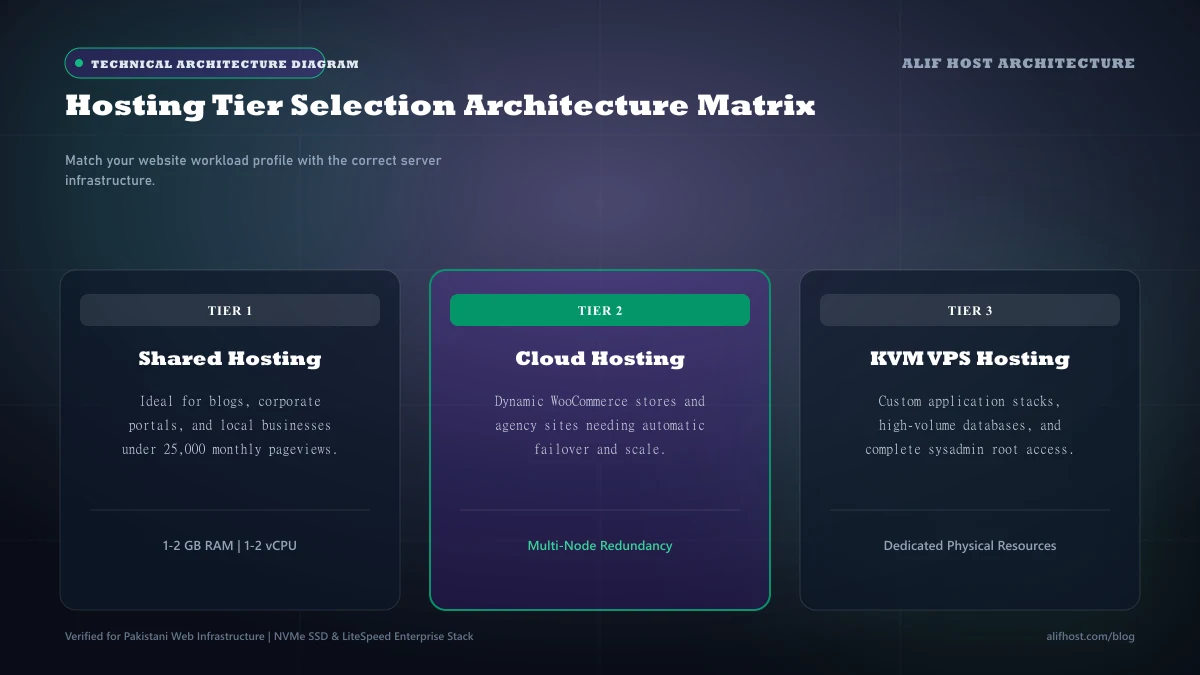
- Monthly Visitor Footprint: New blogs or local corporate sites with under 20,000 monthly visits operate smoothly on high-performance shared hosting. Conversely, sites with heavy concurrent database queries require isolated cloud or VPS compute.
- CMS & Software Stack: WordPress, Joomla, and Magento depend heavily on PHP processing memory and MySQL database read/write speeds, whereas static site generators or Next.js frontends have lower backend database demands.
- Geographic Visitor Proximity: Hosting hardware situated near your primary user demographic minimizes network round-trip latency, directly lowering your Time to First Byte (TTFB) and improving user engagement.
- Expected Concurrency Spikes: Marketing campaigns, seasonal discount events, or news mentions can drive hundreds of visitors simultaneously. Your server must possess sufficient CPU burst capacity to prevent 503 Service Unavailable errors.
- E-Commerce & Payment Compliance: If you process orders online, your server environment must support active SSL certificates, dedicated IP options, and reliable database transaction locks.
Key Technical Specifications That Genuinely Impact Performance
Many hosting providers market misleading claims such as "unlimited storage" or "infinite bandwidth." In real server environments, physical hardware constraints always govern site execution speed. When comparing hosting plans, focus your technical scrutiny on these critical architecture metrics.
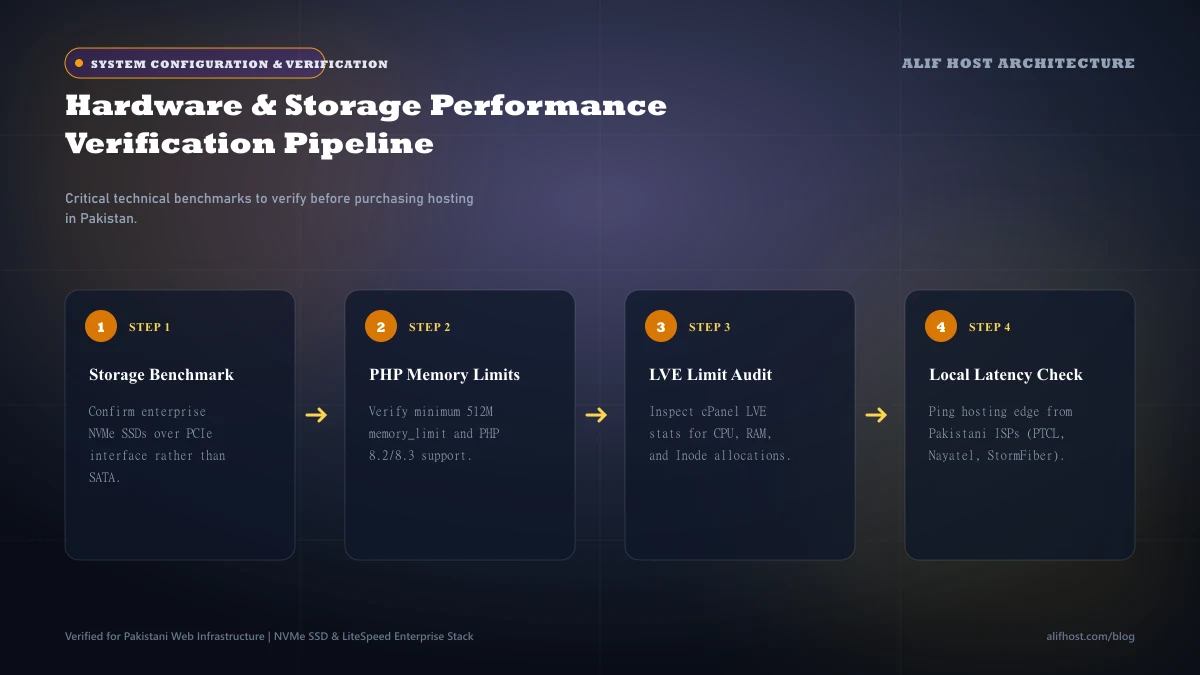
1. Storage Architecture: NVMe SSDs vs Legacy SATA SSDs
Non-Volatile Memory Express (NVMe) solid-state drives interface directly through high-speed PCI Express lanes rather than older SATA controllers. This architectural evolution delivers up to six times higher read/write input/output operations per second (IOPS). For dynamic database-driven applications like WordPress, fast disk I/O ensures complex MySQL queries resolve in milliseconds instead of causing processing bottlenecks.
- Random 4K Read/Write: NVMe excels at retrieving hundreds of small database rows concurrently.
- Data Transfer Speeds: Up to 3,500 MB/s to 7,000 MB/s compared to 550 MB/s on traditional SATA SSDs.
- Reliability under Load: Handles uncompressed image uploads and large database backups without freezing.
2. Web Server Software: LiteSpeed vs Standard Apache
Traditional Apache web servers allocate a distinct execution thread or process for each incoming HTTP request, which rapidly exhausts server physical memory under concurrent visitor spikes. In contrast, LiteSpeed utilizes an event-driven, asynchronous architecture that serves static assets and cached dynamic requests with negligible processor overhead. It also provides native server-level integration with the LiteSpeed Cache (LSCache) engine for WordPress.
3. Allocated Physical RAM and CPU Core Ceilings
On shared platforms, look for the CloudLinux Lightweight Virtual Environment (LVE) limits. A high-quality provider allocates at least 1 GB to 2 GB of physical RAM and 1 to 2 dedicated vCPU cores per account. Providers that refuse to publish their exact memory and CPU quotas typically overcrowd their hardware.
4. Backup Frequency and Automated Disaster Recovery
Hardware crashes, corrupted software updates, and malicious security breaches happen. Your hosting plan must feature automated, off-site daily backups with at least 14 to 30 days of retention, accessible directly via a self-service restore portal in your cPanel dashboard.
Hosting Specification Evaluation Matrix
Use this comparative checklist to evaluate whether a prospective hosting plan meets genuine business standards.
| Technical Feature | Budget Commodity Host | High-Performance Production Host (Alif Host) |
|---|---|---|
| Storage Drive Media | Mechanical HDD or SATA SSD | Enterprise NVMe Solid-State Drives |
| Web Server Daemon | Standard prefork Apache | LiteSpeed with HTTP/3 support |
| CloudLinux LVE Limits | Hidden or heavily throttled | Clearly stated 1 GB to 2 GB RAM / 1-2 vCPUs |
| Database Concurrency | Shared disk I/O bottleneck | Dedicated NVMe MySQL read/write pools |
| Automated Backups | Paid add-on or weekly only | Daily automated snapshots with 1-click restore |
| SSL Encryption | Paid annual certificates | Automated free Let's Encrypt SSL certificates |
| Control Panel | Custom proprietary panel | Industry-standard cPanel control suite |
Pricing Transparency: Beware of Introductory Bait-and-Switch Tactics
One of the most deceptive practices in the hosting industry involves advertising ultra-low promotional rates (such as $1.99 per month) that secretly quadruple upon your first annual renewal. Always calculate your multi-year Total Cost of Ownership (TCO). Check the renewal pricing policy upfront before committing your business data, and review transparent hosting plans and pricing to avoid surprise renewal fees.
- Verify Renewal Pricing: Confirm whether the promotional discount applies to renewals or only to the initial billing cycle.
- Domain Bundling Terms: Ensure that complimentary domain offers (such as our free.com on annual plans) include full DNS management and do not charge predatory transfer fees if you decide to move later. Read our domain brand protection guide to safeguard your digital assets.
- Money-Back Guarantees: Transparent hosts offer a clear refund policy (such as Alif Host's 15-day money-back guarantee on eligible hosting packages), allowing you to test TTFB latency, control panel responsiveness, and support quality risk-free.
- Local Payment Methods & PKR Billing: In Pakistan, foreign hosting invoices in USD incur bank foreign exchange surcharges and statutory advance withholding taxes on international card transactions (such as FBR Section 236Y). Choosing a local provider with transparent PKR billing and support for JazzCash, EasyPaisa, or Raast via our local payment methods guide eliminates foreign exchange fees and cross-border bank charges.
- Transparent Tier Transitions: Verify how smoothly your account transitions from affordable shared hosting to higher-tier cloud hosting or KVM VPS hosting when your visitor concurrency expands.
How to Choose the Right Web Hosting Package in Pakistan
Choosing the right web hosting package in Pakistan requires aligning your expected monthly traffic, database workload, and technical requirements with the right server tier. At Alif Host, all packages include pure enterprise NVMe storage, free automated Let's Encrypt SSL, and local PKR billing via JazzCash, EasyPaisa, and Raast. Use this decision matrix to select your ideal plan:
1. Shared Web Hosting (From PKR 300 per month)
Best Suited For: Personal blogs, portfolios, small business websites, and emerging digital projects. Rather than relying on rigid visitor thresholds, shared hosting comfortably handles lightweight to moderate workloads before database concurrency demands an upgrade.
Multiple accounts share server compute resources while CloudLinux isolates each tenant with dedicated memory (1 GB to 2 GB RAM) and CPU limits. You receive official cPanel management, weekly backups, and free 1-click WordPress installation via Softaculous. Annual Business and Premium plans include a Free .com Domain.
- Starter Hosting (PKR 300/month, or PKR 3,500/year billed annually with a free .info, .site, .store, .online, .website or .xyz domain): 2 websites, 2 GB NVMe SSD, 100 GB Bandwidth, 2 Mail Accounts, 2 Subdomains, cPanel access, and weekly backups.
- Business Hosting (PKR 450/month, or PKR 5,130/year billed annually, a 5% annual discount): 12 websites, 15 GB NVMe SSD, Unlimited Bandwidth, 10 Mail Accounts, 12 Subdomains, cPanel access, weekly backups, and a Free .com Domain with an Annual Plan.
- Premium Hosting (PKR 800/month, or PKR 8,640/year billed annually, a 10% annual discount): 50 websites, 55 GB NVMe SSD, Unlimited Bandwidth, 50 Mail Accounts, 50 Subdomains, cPanel access, weekly backups, and a Free .com Domain with an Annual Plan.
2. LiteSpeed WordPress Hosting (From PKR 400 per month)
Best Suited For: Content publishers, dynamic WordPress blogs, corporate portfolios, and growing WooCommerce stores requiring fast database query execution.
Built specifically on LiteSpeed Web Server with server-level LSCache integration. Unlike standard shared servers, WordPress plans include elevated PHP memory limits, MariaDB InnoDB database tuning, and WP Toolkit for staging sandboxes, automated security patching, and plugin management.
- WP Starter (PKR 400/month, or PKR 4,800/year billed annually): 3 websites, 4 GB NVMe Storage, 100 GB Bandwidth, LiteSpeed Cache, and automated core updates.
- WP Business (PKR 600/month or PKR 570/month billed annually at PKR 6,840/year): 15 websites, 20 GB NVMe Storage, Unlimited Bandwidth, 15 emails, daily automated backups, and Free .com Domain with an Annual Plan.
- WP Pro (PKR 900/month or PKR 765/month billed annually at PKR 9,180/year): 40 websites, 50 GB NVMe Storage, Unlimited Bandwidth, 40 emails, daily backups, and Free .com Domain with an Annual Plan.
3. White-Label Reseller Hosting (From PKR 1,200 per month)
Best Suited For: Web design agencies, freelance developers, and digital entrepreneurs managing client websites in Pakistan.
Reseller hosting provides master WebHost Manager (WHM) access, allowing you to create custom hosting packages, allocate storage quotas, and provision isolated, independent cPanel accounts for each customer under your own brand with private nameservers (ns1.yourbrand.com).
- Reseller Basic (PKR 1,200/month or PKR 1,080/month billed annually): 50 cPanel accounts, 60 GB NVMe SSD storage, full WHM access, white-label branding, and Free .com Domain with an Annual Plan.
- Reseller Business (PKR 1,700/month or PKR 1,530/month billed annually): 75 cPanel accounts, 80 GB NVMe SSD storage, daily automated backups, and Free .com Domain with an Annual Plan.
- Reseller Pro (PKR 2,600/month or PKR 2,106/month billed annually): 150 cPanel accounts, 200 GB NVMe SSD storage, priority technical support, and Free .com Domain with an Annual Plan.
4. Dedicated KVM Linux VPS Hosting (From PKR 2,600 per month)
Best Suited For: Busy eCommerce platforms, custom Laravel/Node.js web apps, software houses, and production workloads needing dedicated compute resources.
Kernel-based Virtual Machine (KVM) virtualization delivers dedicated virtual CPU cores, dedicated RAM, and NVMe disk space with virtual machine isolation. You receive dedicated SSH terminal access in an isolated virtual compute environment to configure your application runtime, manage environment services, and deploy custom stacks.
- Dedicated virtual compute: Hardware-level KVM virtualization protects your server from neighboring tenant resource contention.
- Dedicated SSH terminal access: Manage your virtual server environment, configure custom software runtimes, Node.js, Python, or specialized database stacks.
- Predictable local PKR billing: Consistent local rates immune to international currency fluctuations and credit card decline errors.
Step-by-Step Decision Framework for Launching Your Project
Follow this sequential workflow to identify the exact hosting tier your website requires today:
- Step 1: If building a personal blog, company brochure, or early-stage shop with modest traffic, start on Shared Hosting Starter, Business, or Premium. Compare architectures in our shared vs VPS hosting guide or learn foundational mechanics in what is web hosting.
- Step 2: If running an active WooCommerce store with 500+ products or requiring custom background workers, choose WordPress Hosting or entry-level KVM VPS Hosting. Consult our WooCommerce speed and scaling guide to optimize your store for flash sales.
- Step 3: If managing multi-tenant client sites or starting a digital agency, select Reseller Hosting to deploy isolated cPanel accounts for each customer. Read our comprehensive guide on how Pakistani agencies resell hosting to build recurring retainer income.
- Step 4: Secure your brand identity early by checking domain availability on our domain search and registration portal, comparing extensions like .com and .pk.
- Step 5: Still calculating disk space, bandwidth, or budget requirements? Review all package tiers side-by-side on our all hosting plans & pricing page, use our interactive Hosting Cost & Resource Calculator, or inspect comparative breakdowns on our Hosting Comparison Tool.