


The Pakistani E-Commerce Landscape in 2026: The Battle of Two Giants
In short: Shopify vs WooCommerce in Pakistan: Shopify is easier to start but charges a monthly USD fee plus extra fees on third-party gateways, while WooCommerce is free software that runs on your own hosting and works with local gateways like JazzCash and Easypaisa.
E-commerce in Pakistan is growing fast. Retail brands, fashion houses, and direct-to-consumer stores generate millions in monthly online sales.
When launching an online store, sellers face a major platform decision: Shopify or WooCommerce?
International reviews focus mainly on ease of use. However, running a store in Pakistan involves local realities that change the financial math:
- Payment Gateways: Shopify Payments is unavailable in Pakistan.
- Third-Party Gateway Fees: Shopify charges an extra 0.6% to 2.0% fee on external gateways.
- Currency Risk: Monthly SaaS bills in USD add currency volatility and bank taxes.
- Local Integrations: Native COD courier APIs and local PKR wallets (JazzCash, Easypaisa).
This guide compares the true costs, gateway fees, and hosting infrastructure for both platforms.

- Payment Gateway Penalty: Because Shopify Payments does not operate in Pakistan, Shopify penalizes merchants with an additional 0.6% to 2.0% transaction fee on every sale.
- Currency Exposure: Shopify plans bill monthly in US Dollars ($29 to $399+/month), which exposes Pakistani businesses to ongoing rupee depreciation and banking withholding taxes.
- Zero Platform Tax with WooCommerce: WooCommerce is 100% free and open-source, charging exactly 0% platform transaction fees regardless of monthly gross revenue.
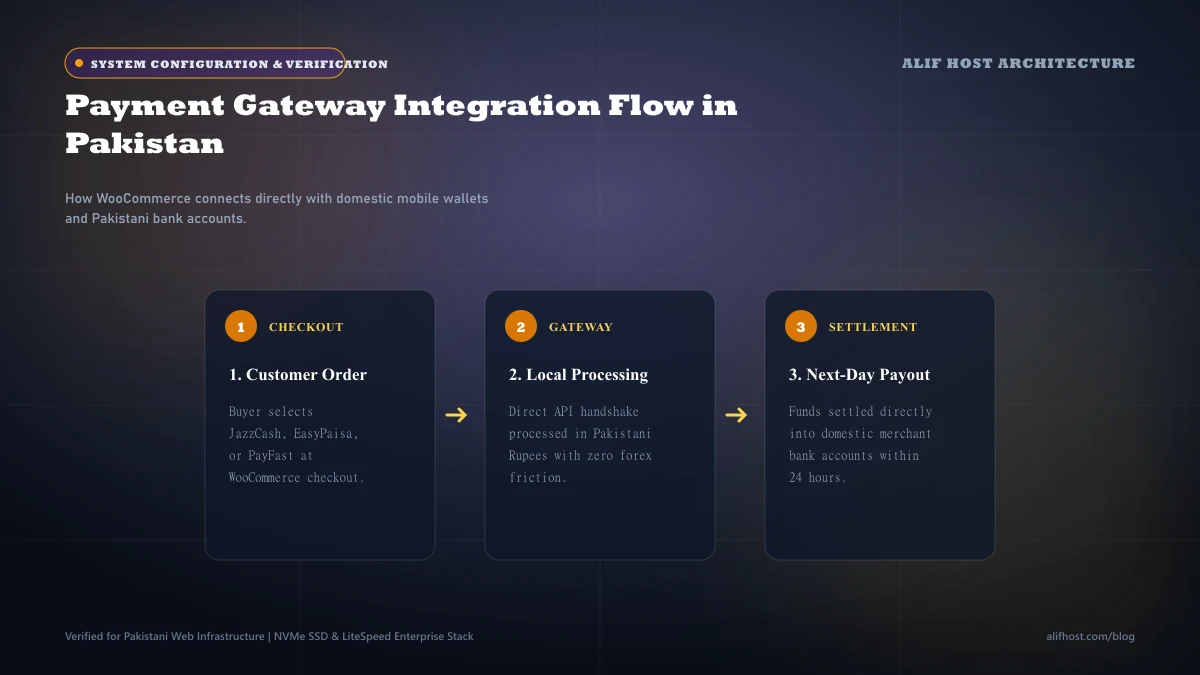
- Local Gateway Freedom: WooCommerce connects natively to Pakistani payment gateways and mobile wallets (JazzCash, Easypaisa, Raast, PayFast, Safepay) with zero intermediate penalties.
The Hidden Tax: Shopify's 2.0% Third-Party Gateway Fee in Pakistan
The single most overlooked financial factor when choosing Shopify in Pakistan is its international payment processing architecture. In North America and Western Europe, Shopify offers its native processor, Shopify Payments. When merchants utilize Shopify Payments, Shopify waives all additional transaction fees.
However, Shopify Payments is not available for Pakistani corporate entities or bank accounts. Consequently, Pakistani Shopify merchants are required to integrate third-party payment aggregators or bridging apps (such as Safepay, UnumPay, PayFast, or custom API connectors). Under Shopify's terms of service, whenever a merchant processes a transaction through an external gateway, Shopify levies a mandatory third-party transaction fee:
- Basic Shopify Plan ($29/month): 2.0% additional fee per order.
- Shopify Plan ($79/month): 1.0% additional fee per order.
- Advanced Shopify Plan ($399/month): 0.6% additional fee per order.
This 2.0% fee is extracted on top of whatever your payment aggregator already charges for merchant processing (typically 2.5% to 3.5%). On an e-commerce store processing PKR 2,000,000 per month, that 2.0% penalty translates into PKR 40,000 handed directly to Shopify every single month, simply for routing customer orders to your payment gateway.
With WooCommerce on WordPress hosting, there is zero platform fee. Whether you generate PKR 100,000 or PKR 100,000,000 in monthly sales, WooCommerce takes zero percentage of your top-line revenue.
| Store Revenue Tier | Shopify Basic (Monthly Cost) | WooCommerce on Alif Host | Annual Profit Retained with WooCommerce |
|---|---|---|---|
| PKR 500,000 / mo (Starter) | ~$29 sub (PKR 8,400) + 2% fee (PKR 10,000) = PKR 18,400/mo | Hosting: PKR 450/mo (Business plan) | Save about PKR 215,400 per year |
| PKR 2,000,000 / mo (Growing) | ~$79 sub (PKR 22,800) + 1% fee (PKR 20,000) = PKR 42,800/mo | Hosting: PKR 950/mo (Cloud Starter) | Save about PKR 502,200 per year |
| PKR 5,000,000 / mo (Established) | ~$299 sub (PKR 86,000) + 0.6% fee (PKR 30,000) = PKR 116,000/mo | VPS Business: PKR 6,899/mo | Save about PKR 1,309,200 per year |
Payment Gateway Ecosystem: Integrating JazzCash, Easypaisa, Safepay, and Raast
Payment checkout success rates directly determine e-commerce survival in Pakistan. If a customer attempts to pay with a local debit card or mobile wallet and the gateway fails, over 70% of shoppers will abandon their cart and buy from a competitor.
Let us analyze how each platform handles domestic Pakistani payment methods:
1. Mobile Wallets (JazzCash & Easypaisa)
Over 60 million active mobile wallets exist across Pakistan. On WooCommerce, official open-source and developer-supported plugins enable direct integration with JazzCash Merchant API and Easypaisa Online Payment Gateway. Customers can enter their mobile account number and confirm the payment via OTP or in-app biometric authorization directly inside your checkout flow.
On Shopify, connecting JazzCash or Easypaisa requires third-party bridging apps or aggregators (such as UnumPay or Safepay Checkout), adding extra integration steps and third-party SaaS monthly charges.
2. State Bank of Pakistan's Raast Instant Payment Rails
Raast is revolutionizing digital retail payments in Pakistan by eliminating intermediary merchant clearing fees. WooCommerce open-source hooks allow developers to generate dynamic QR codes and instant payment requests linked to your store's Raast IBAN. Shopify's closed hosted architecture strictly prohibits custom code modifications to the checkout page on standard plans (checkout customization is locked exclusively to Shopify Plus plans starting at $2,000/month).
3. Manual Direct Bank Wire Uploads
Many Pakistani luxury, high-ticket, and B2B stores rely on customers making direct 1Link online bank transfers. WooCommerce offers free, built-in functionality for customers to place an order in 'On-Hold' status and upload proof-of-payment receipts directly to their account dashboard for instant admin verification.
Cash on Delivery (COD) Logistics & Courier Integrations
Despite the rapid rise of digital payments, Cash on Delivery (COD) still accounts for roughly 65% to 80% of all e-commerce order volume across Pakistan. Managing COD successfully requires automated logistics synchronization with premier domestic courier networks:
- TCS Express API
- Leopards Courier Service (LCS) API
- Trax Logistics API
- CallCourier / PostEx API
- Rider / BlueEx API
On WooCommerce, extensive and mature Pakistani developer plugins allow automatic shipping label generation, real-time CN tracking number generation, automated weight calculation, and SMS order verification via local Pakistani gateways (such as Jazz, Zong, Telenor, and Twilio SMS) right from the WordPress order management screen.
On Shopify, while courier apps exist in the Shopify App Store, many charge recurring monthly subscription fees in USD to unlock automated booking, adding another $10 to $30 per month to your operational overhead.
Server Infrastructure Requirements for Scaling WooCommerce in Pakistan
The most common critique of WooCommerce is that it can become sluggish if hosted on low-quality, oversold server infrastructure. Unlike static brochure websites, an active e-commerce store executes intensive MySQL queries on every cart update, price recalculation, and inventory checkout.
To ensure WooCommerce loads under 1.2 seconds and processes simultaneous flash sale traffic effortlessly, deploy on modern, performance-engineered WordPress hosting with these core requirements:
- LiteSpeed Web Server (LSWS) + LSCache: LiteSpeed processes dynamic PHP requests up to 8x faster than traditional Apache, utilizing server-level tag caching to purge WooCommerce product updates instantly without clearing entire sitewide caches.
- In-Memory Redis Object Caching: Caches heavy database queries (such as
wp_postmetaand product attributes) in RAM, eliminating repeated disk queries and drastically reducing checkout latency. - High PHP Memory Limit: Allocate at least 512 MB to 1,024 MB of PHP execution memory to prevent memory exhaustion during simultaneous checkout executions.
- Enterprise NVMe Storage: Pure PCIe Gen4 NVMe arrays deliver over 1,000,000 IOPS, ensuring bulk product imports and WooCommerce database searches execute in milliseconds.
- HTTP/3 over QUIC Protocol: Ensures rapid re-connection on Pakistani mobile 4G/5G networks when customers experience fluctuating cellular signal strength.
Platform Comparison Summary: Making the Right Decision for 2026
Here is our definitive verdict based on business scale and technical resources:
| Decision Factor | Shopify | WooCommerce | Strategic Winner |
|---|---|---|---|
| Initial Setup Speed | Extremely fast (1-2 days, no technical knowledge needed) | Moderate (requires WordPress setup and theme configuration) | Shopify (Faster time to market) |
| Ongoing Monthly Overhead | High ($29 to $399/mo in USD + 2% transaction fee) | Very Low (PKR 300 to PKR 3,000/mo for Alif Host shared to cloud hosting) | WooCommerce (Massive cost advantage) |
| Data & Platform Ownership | Proprietary SaaS (Shopify owns server environment; account can be suspended) | 100% Data Ownership (Self-hosted on your own database) | WooCommerce (Zero risk of platform ban) |
| Checkout Customization | Locked (Only available on $2,000/mo Shopify Plus) | 100% Customizable via PHP, Hooks & CSS | WooCommerce (Complete control) |
| Maintenance Responsibility | Zero maintenance (Managed by Shopify engineers) | Merchant manages updates, backups, and security | Shopify (Hassle-free maintenance) |
| Local Gateway Flexibility | Limited to third-party aggregators with extra fees | Native support for JazzCash, Easypaisa, Raast, Manual Bank Transfer | WooCommerce (Native Pakistani ecosystem) |