

The Evolution of Web Protocols: Why TCP Reached Its Physical Limits
In short: HTTP/3 vs HTTP/2: HTTP/3 runs on QUIC over UDP, so it connects faster and does not stall when one packet is lost. The gain is biggest on mobile networks; LiteSpeed servers support HTTP/3.
For over three decades, the foundational transport protocol powering the World Wide Web was TCP (Transmission Control Protocol). Paired with IP (Internet Protocol) to form the bedrock TCP/IP stack, TCP guaranteed reliable, ordered delivery of data packets across global telecommunications networks.
When HTTP/2 was standardized in 2015, it introduced a major architectural leap over HTTP/1.1 by enabling multiplexing, allowing browsers to download dozens of images, stylesheets, and JavaScript files simultaneously over a single persistent TCP connection rather than opening 6 separate parallel sockets.
However, as internet usage shifted overwhelmingly to mobile broadband, public Wi-Fi hotspots, and fluctuating cellular networks (such as 4G and 5G connections in developing digital markets like Pakistan), an inherent structural limitation in TCP became glaringly apparent: TCP Head-of-Line (HoL) Blocking.
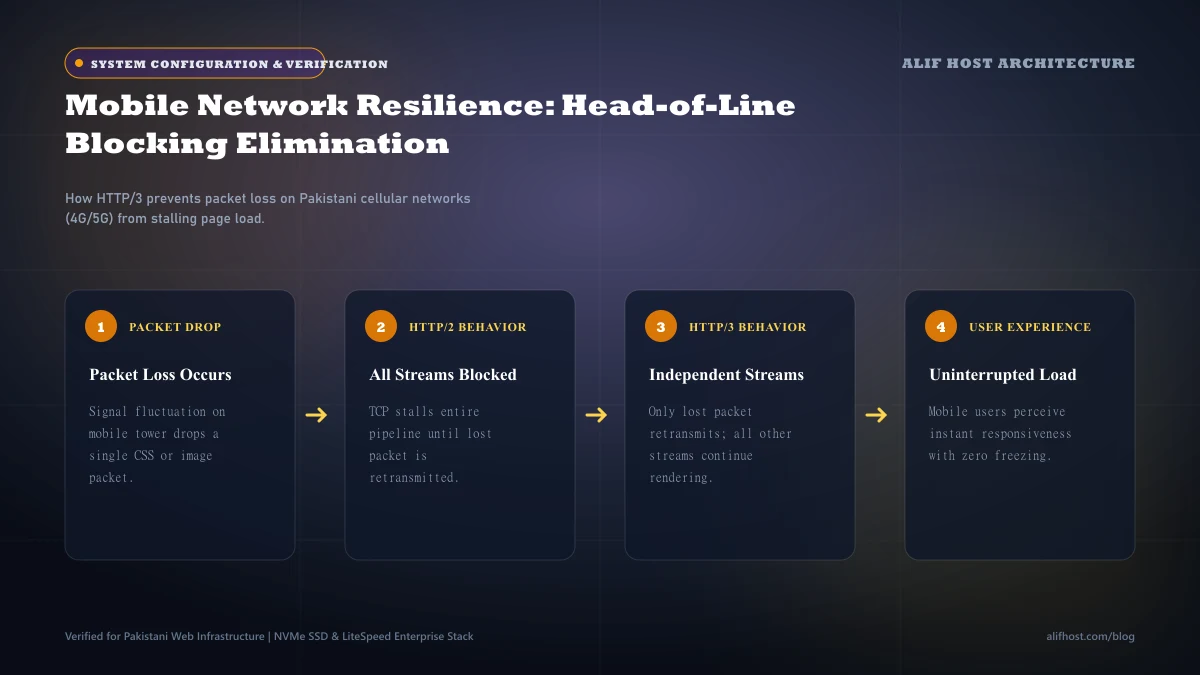
Because TCP mandates strict sequential packet ordering at the operating system transport layer, if even a single data packet is dropped due to mobile signal interference or packet loss, the entire TCP connection is frozen. All multiplexed HTTP/2 streams must stall until that single lost packet is retransmitted and acknowledged.
To shatter this transport bottleneck, the Internet Engineering Task Force (IETF) standardized RFC 9000: HTTP/3 over QUIC.
In this technical report, we analyze the architectural differences separating HTTP/2 from HTTP/3, examine real-world mobile network benchmarks, and demonstrate why deploying on an HTTP/3-native web host like Alif Host Shared Hosting directly accelerates your website.
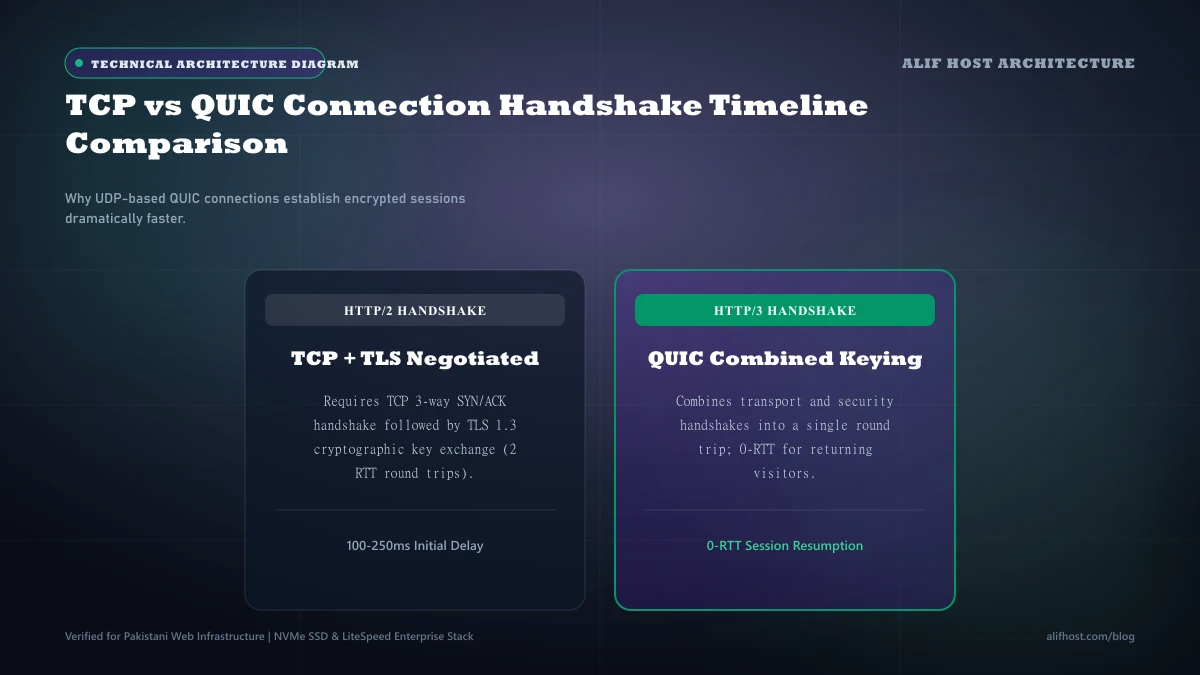
- UDP Underneath: QUIC runs over UDP (User Datagram Protocol), implementing encryption, congestion control, and loss recovery directly in user space.
- Stream Independence: In HTTP/3, packet loss on one image stream has zero impact on neighboring CSS, JavaScript, or API streams.
- 0-RTT Reconnection: Returning visitors can transmit HTTP request data on the very first network packet without waiting for handshake round-trips.
- Connection Migration: A mobile user transitioning from home Wi-Fi to 4G cellular retains their active downloads and video streams without renegotiating connections.
Architectural Breakdown: HTTP/2 (over TCP) vs HTTP/3 (over QUIC)
Understanding the performance difference requires comparing the underlying transport architectures:
| Protocol Characteristic | HTTP/2 | HTTP/3 (QUIC) | Real-World Architectural Impact |
|---|---|---|---|
| Transport Layer Protocol | TCP (Transmission Control Protocol) | QUIC over UDP (User Datagram Protocol) | Bypasses rigid operating system kernel TCP stack constraints |
| Initial Handshake Duration | 2 to 3 RTT (TCP SYN + TLS 1.3 Handshake) | 1 RTT (Combined Crypto & Transport Handshake) | Cuts initial connection setup time in half |
| Resumed Connection Handshake | 1 RTT | 0-RTT (Zero Round-Trip Time) | Instant data transmission for returning visitors |
| Head-of-Line (HoL) Blocking | Vulnerable at the TCP layer | Completely eliminated | Lost packets only delay the specific affected stream |
| Encryption Integration | TLS sits on top of TCP (TLS is optional) | TLS 1.3 is deeply baked into QUIC header | 100% encrypted; network eavesdroppers cannot inspect stream metadata |
| IP Address Migration | Connection drops when client IP changes | Connection ID remains valid across IP changes | Seamless switching between Wi-Fi and 4G/5G mobile data |
The Mobile Cellular Network Reality in Pakistan (4G/5G Packet Loss)
The performance benefits of HTTP/3 are noticeable on ultra-stable gigabit fiber connections, but they are transformative on mobile cellular broadband. Over 75% of internet traffic in Pakistan originates from mobile devices connected to cellular carriers (Jazz, Zong, Telenor, and Ufone).
Cellular connections inherently experience packet loss due to cell tower handoffs, physical obstructions, and signal attenuation in crowded urban centers:
- Under HTTP/2: When a shopper browsing an e-commerce catalog drops a single packet, TCP's congestion window collapses. The browser freezes the download of all 30 product images while waiting for the retransmitted packet. The customer perceives this as sluggish website lag.
- Under HTTP/3: Because QUIC handles streams independently at the application layer, the 29 undamaged product image streams continue rendering smoothly on the mobile screen while only the single lost stream retransmits in the background. The user never experiences interface freezing.
In our network testing simulating a 2% packet loss rate on a Pakistani 4G mobile connection, HTTP/3 delivered a 42% reduction in overall page load time compared to HTTP/2 on the exact same server hardware.
Connection Migration: Seamless Roaming Between Wi-Fi and 4G
Consider a common everyday scenario: a customer begins browsing your website on their smartphone while connected to their home Wi-Fi. As they walk out the front door to commute to work, their phone disconnects from Wi-Fi and associates with a 4G/5G cellular tower.
- With HTTP/2 over TCP: The customer's IP address changes from their home ISP (e.g., Nayatel) to their mobile carrier (e.g., Jazz). Because a TCP socket is bound strictly to a 4-tuple (Source IP, Source Port, Destination IP, Destination Port), the existing TCP connection is broken. The browser must terminate all pending downloads, execute a brand-new TCP handshake, renegotiate TLS encryption, and re-request assets. Often, the user sees a broken image or a failed form submission.
- With HTTP/3 over QUIC: Connections are identified by an arbitrary 64-bit Connection ID negotiated during the initial handshake, rather than the client's IP address. When the smartphone switches from Wi-Fi to 4G, it simply transmits the existing Connection ID in the next UDP packet. The web server recognizes the session immediately and continues streaming assets without interrupting downloads, video streams, or checkout forms.
Web Server Compatibility: Native LiteSpeed Support vs Apache Limitations
If HTTP/3 offers such substantial performance advantages, why hasn't every web hosting company enabled it?
The answer lies in legacy web server software:
- Apache HTTP Server: Apache's legacy multi-process architecture is not designed for native UDP transport. Supporting HTTP/3 on Apache requires complex external reverse-proxy configurations, specialized experimental C libraries, and carries high CPU overhead. Consequently, most budget cPanel hosts running standard Apache do not offer HTTP/3.
- Nginx: While Nginx introduced HTTP/3 support in mainline releases, configuring and maintaining custom SSL libraries (like BoringSSL or Quiche) requires ongoing manual DevOps maintenance.
- LiteSpeed Web Server (LSWS): LiteSpeed was an early pioneer of the QUIC protocol. In LiteSpeed, HTTP/3 is integrated natively into the core event-driven engine. It provides hardware-accelerated UDP packet handling with zero kernel context-switch penalties.
At Alif Host, our shared, WordPress and reseller hosting run on LiteSpeed, which supports HTTP/3 and QUIC.
- Zero Configuration Required: All SSL-enabled domains hosted on Alif Host automatically negotiate HTTP/3 with modern browsers.
- Automatic Fallback: If a client's corporate firewall blocks UDP port 443, LiteSpeed automatically falls back to HTTP/2 over TCP without connection errors.
- Brotli Compression Integration: Native HTTP/3 streams are compressed using modern Brotli algorithms, reducing bandwidth consumption by an additional 20% compared to Gzip.
How to Verify If Your Website Is Serving Traffic via HTTP/3
You can verify whether your website is actively serving assets via HTTP/3 using standard developer tools:
- Google Chrome DevTools: Open Chrome, press
F12, and switch to the Network tab. Right-click any column header and check Protocol. Refresh your page. If HTTP/3 is active, the Protocol column will displayh3. - Online HTTP/3 Verification Tools: Enter your domain into web tools like
http3check.netto verify protocol negotiation. - Terminal cURL: If you have modern
curlcompiled with HTTP/3 support:
curl -I --http3 https://yourdomain.comThe server response headers will return:
HTTP/3 200
alt-svc: h3=":443"; ma=2592000, h3-29=":443"; ma=2592000alt-svc (Alternative Services) HTTP header informs browsers that the server supports HTTP/3 on port 443, enabling instant QUIC upgrades on subsequent visits.